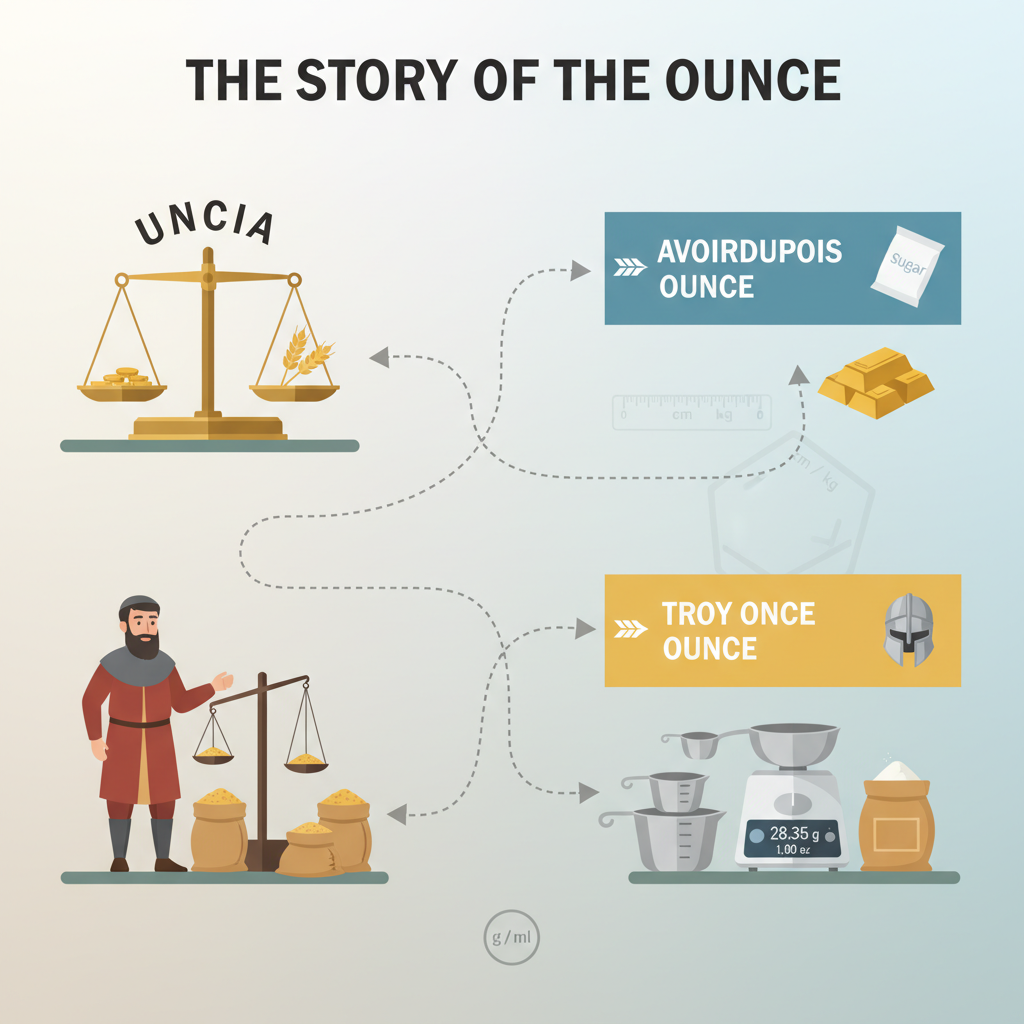
Did you know that the ounce, a unit of weight many of us use daily, has roots stretching back over two thousand years? It’s a testament to its enduring utility that this ancient measurement still holds a place in our modern world. But where did it come from, and why haven’t we completely replaced it with metric units?
From Ancient Rome to Modern Kitchens: The Origin of the Ounce
The story of the ounce begins in ancient Rome. The Romans used a system of weights and measures that was widely adopted throughout their empire. Their unit of weight, the uncia, was originally one-twelfth of a Roman pound (the libra). This division into twelve parts was common in Roman systems, influencing many other measurements. The word “ounce” itself is derived directly from this Latin term, uncia.
As Roman influence spread, so did the uncia. Different regions and cultures adapted the measurement, often linking it to their own local pound weights. Over centuries, these variations led to different types of ounces. For instance, the avoirdupois ounce, which is the most common in the United States and the United Kingdom today, is defined as 1/16th of an avoirdupois pound. This is the ounce we typically encounter when weighing food ingredients or personal care products.
However, there’s also the Troy ounce, which is slightly heavier and is still used for weighing precious metals like gold and silver. This historical divergence highlights how the ounce evolved differently depending on its application.
Why Do We Still Use the Ounce Today?
Despite the global adoption of the metric system (which uses grams and kilograms), the ounce persists for several key reasons:
1. Tradition and Familiarity
In countries like the United States, the imperial system, which includes the ounce, has been in place for centuries. Generations have grown up using ounces for cooking, baking, and everyday purchases. This ingrained familiarity makes it difficult to transition away from, especially for older generations or in specific industries. As noted by the National Institute of Standards and Technology (NIST), the US is one of the few countries that has not fully adopted the metric system for everyday commerce. [1]
2. Convenience in Certain Applications
For small quantities, the ounce can be a very practical unit. Think about recipes that call for 4 ounces of butter or 2 ounces of chocolate chips. Using grams for these small measurements can result in numbers with many decimal places, which can be less intuitive for home cooks. An ounce often represents a manageable portion size that is easy to visualize.
3. Specialized Industries
As mentioned, the troy ounce remains the standard for weighing precious metals. This is a deeply entrenched practice in the global commodities market. Similarly, in some pharmaceutical and chemical applications, ounces might still be used due to historical practices and specific product formulations.
4. Cultural Inertia
Changing measurement systems on a national scale is a massive undertaking. It requires updating regulations, re-educating the public, and potentially re-tooling manufacturing processes. This inertia, combined with the practical reasons above, ensures the ounce continues to be a part of our measurement landscape.
Conclusion
The ounce, born from the Roman uncia, has navigated centuries of history, adapting and persisting even as global measurement systems have evolved. Its continued use, particularly in the United States and in specialised fields like precious metals trading, is a blend of deep-rooted tradition, practical convenience for certain quantities, and the sheer inertia of established systems. While the metric system offers a more universally standardised approach, the humble ounce continues to weigh in on our daily lives.